
The em dash has been a staple of great writing for centuries—from Shakespeare to Dickens to Brontë. It's become a bit of an AI tip-off, but that doesn't mean you should stop using it.
A few months back, I was having a friendly conversation with one of our clients about the copy we'd written for her website. During that chat, she brought up concerns that some of what we delivered seemed like it had been written by AI—which, of course, concerned me quite a bit, especially since I'd written it myself. I asked her to elaborate on why she felt that way, and she pointed specifically to the use of the em dash in the copy. She followed up with an explanation that she'd read (or heard) somewhere that the em dash (—) was a telltale sign that copy had been written by AI. (Here's one source of this viewpoint.)
I tried not to appear too offended (I really wasn't), and assured her that the em dash was something I'd used regularly going back to my college days in the '90s, while pursuing my journalism degree at Boston University (COM '98).
The striking thing, though, is that she's also right. The em dash does show up—a lot—in AI-generated content (try it for yourself and you'll have a hard time missing it). Since this was brought to my attention, I've caught myself feeling a bit self-conscious, on numerous occasions, looking for a way to swap out my go-to em dash with something else: commas, parentheses, or even…ellipses (gross). Eventually, I came to this conclusion: screw it. I'm using the em dash—forever. I love it. And the rest of my team can too. We'll just have to create some kind of disclaimer.
So, here we are. Oh, and before I forget—I wrote this whole post. All by myself.
The em dash has a long and somewhat murky history, potentially dating back to the late 1100s or early 1200s. The Florentine rhetorician Boncompagno da Signa used a mark called the virgula plana (—) for long pauses in his vernacular Italian writing—one of the earliest known ancestors of the modern dash. (Learn a bit more about all that here.)
But for me, the most important early example of the em dash in action has to be Shakespeare. King Lear is full of dashes, particularly in moments where a character's thought breaks or reverses mid-sentence. Here is Lear's eruption at Goneril and Regan—a mind so overcome with rage that it can't finish its own threat:
"I will have such revenges on you both / That all the world shall—I will do such things—/ What they are, yet I know not."
— King Lear, Act 2, Scene 4 (First Folio, 1623)
By the way, you can read more of that scorcher here.
We also see the em dash used liberally by other greats:
Charles Dickens, in Chapter 2 of Oliver Twist (1837), uses dashes for satirical effect, showing Mr. Bumble's hypocrisy in real time as he praises a woman while helping himself to her gin:
"No," said Mr. Bumble approvingly; "no, you could not. You are a humane woman, Mrs. Mann."—(Here she set down the glass.)—"I shall take an early opportunity of mentioning it to the board, Mrs. Mann."—(He drew it towards him.)—"You feel as a mother, Mrs. Mann."—(He stirred the gin and water.)—"I—I drink your health with cheerfulness, Mrs. Mann;"
Herman Melville, in Chapter 135 of Moby-Dick (1851), deploys dashes as Ahab's mind races toward its final reckoning:
"The same—the same!—the same to Noah as to me. There's a soft shower to leeward. Such lovely leewardings! They must lead somewhere—to something else than common land, more palmy than the palms."
And Charlotte Brontë, on pretty much every page of Jane Eyre (1847), uses dashes to give Jane's voice its fierce, declarative rhythm:
"Do you think I am an automaton?—a machine without feelings? and can bear to have my morsel of bread snatched from my lips, and my drop of living water dashed from my cup? Do you think, because I am poor, obscure, plain, and little, I am soulless and heartless? You think wrong!—I have as much soul as you,—and full as much heart!"
We can see that the em dash has been around—and used effectively—for a very long time.
I can remember using the em dash pretty early in my academic career—certainly by middle school. I know it was long enough ago that when word processing software started automatically reformatting my double dashes (--) into proper em dashes, I was genuinely astonished. I still use the double-dash technique.
The em dash has been part of my writing style for as long as I can remember. So much so, in fact, that I never thought much about whether I used it more or less than my contemporaries. But I have to conclude that I must have been in the minority, since it now seems to stick out like a sore thumb as an AI tell.
The em dash shows up frequently in AI output for a reason that has nothing to do with the mark itself: large language models are trained on vast collections of edited, published prose—journalism, novels, essays—where the em dash is standard punctuation. In years past, as companies like Anthropic, OpenAI, and others expanded their training data, they turned to digitized print books from earlier decades, picking up the stylistic habits of classic literature along the way.
In other words, AI uses em dashes because good human writers have used them for centuries. Shakespeare, Austen, Dickens, Melville, Brontë, Dickinson, Vonnegut—they all used it. The mark didn't become suspect because AI invented it; it became a hallmark because AI learned it from great human writing.
Perhaps the reason it stands out more now is that AI is applying its training on classic literature to the kinds of writing more commonly consumed today—emails, texts, social media posts—where that kind of literary punctuation isn't the norm.
And perhaps the em dash will continue to tip people off to the use of AI, which in and of itself isn't a bad thing. But at Propagate, we'll keep using it—not because we fancy ourselves a crew of modern-day Herman Melvilles, but because we were using it long before the machines caught on, and it's a wonderful little piece of punctuation.
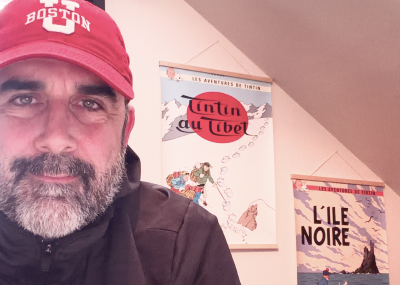
Mike McKenna is the founder and president of Propagate, leading a dynamic team that guides client ideas from concept through execution and beyond. Mike has been planning, writing, designing, and coding for the web since 1995. His background in web development and journalism—he holds a bachelor's degree from Boston University—makes him both technically savvy and an exceptional writer and storyteller. Combined with his extensive experience in business strategy, he leads with creative vision and practical execution.

Learning about your organization, goals, and challenges is the first step to us helping you propagate your ideas. Let's get on a call for 30 minutes to chat. We want to know all about you and what fuels you.
Schedule 30 Minutes with Us.
We'd love to hear about your ideas, challenges, and thoughts.