
An example of how to use Claude Code to create lightweight, effective software for your own daily use.
My current view on using AI for coding is simple: while it's exciting to think about how I could, in theory, prompt an agent and watch it spit out the next million-dollar SaaS idea, the reality is that there are much smaller, more practical fish to fry that can get me real-world wins much sooner. This post is about how I made reconciling the books much easier and faster.
First, I built a lightweight bookkeeping system with a simple API. Nothing fancy—it tracks a chart of accounts, bank imports, journal entries, and generates the standard reports (trial balance, P&L, balance sheet). The important part is that every bookkeeping action is an API call. So, importing a statement, categorizing transactions, posting a journal entry, etc.—everything hits the API.
Once your bookkeeping actions are using API calls, Claude Code can run them for you.
When I'm ready to do my monthly reconciliation, I just download my statements (our bank, Santander, has some pretty limited options here, so I am using the raw text version for now), launch Claude Code, and say something like: "Let's reconcile last month's books."
From there, a few simple things happen in the background.
Import. Claude reads the bank export file, creates an import record, and stages every transaction for review. This used to be a manual upload-and-map process. Now it's done in a few seconds!
Auto-categorize. I have a set of categorization rules set up in my database. These are basically pattern-matching rules that look at each transaction's description and assign it to the appropriate account. For example, an expense paid to "STRIPE" goes to software expenses, and "ACH DEPOSIT [CLIENT NAME]" goes to revenue. Most transactions get categorized automatically. (About 85% right now.)
Work through the unknowns. Claude notes anything that didn't match a rule and asks me about it. "There's a $2,400.00 charge from CONSOLIDATED MERCHANT—what is that?" I tell it, it categorizes it, and—here's the fun part—it creates a new rule so that transaction auto-categorizes next time. The system gets smarter every month as a result.
Approve and post. Once everything is categorized, I approve the transactions and the system creates journal entries—debits and credits, posted to the right accounts. Every entry links back to the original bank transaction for traceability.
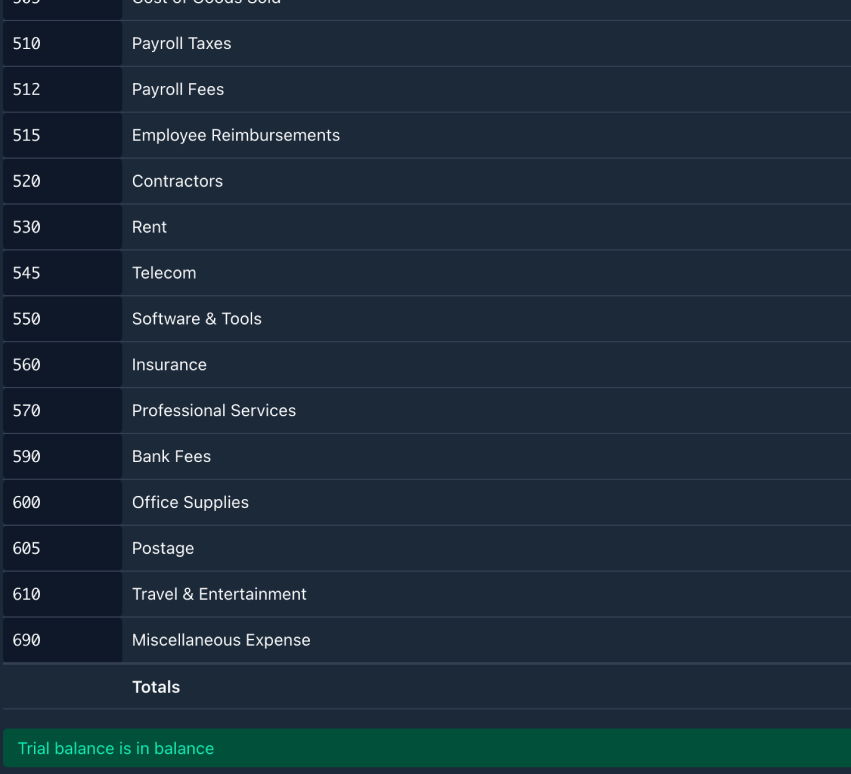
Verify. Claude pulls the trial balance and checks that debits equal credits. If they don't, it stops, and we find the discrepancy before moving on. Then it pulls the P&L and flags anything unusual—a spending category that spiked, a specific client's revenue that dropped, an expense that doesn't look right, etc.
The whole thing takes about ten minutes. It used to take me a couple of hours.
The categorization rules are the best part. Month one, maybe 60% of your transactions auto-categorize (and you'll have to confirm every transaction. You spend time teaching the system: this vendor goes here, that recurring charge goes there. Month two, almost everything auto-categorizes. By month four or five (I'm on month 3), I hope to be dealing only with genuinely new transactions. I expect everything else to just flow through.
This isn't AI sorcery, it's just pattern-matching against a growing ruleset. But having Claude Code manage the rules, run the imports, and handle the posting means I'm not clicking through a UI stage-by-stage, transaction-by-transaction to do any of it.
I built decision frameworks for the surprises too. If Claude encounters a transaction it's not sure about, it doesn't guess. It asks. If the trial balance is off, it stops everything until the discrepancy is found. If an expense category spikes more than 50% over last month, it flags it before I even ask.
These aren't complex AI features—they're just rules, written in plain English in an operations manual that Claude reads at the start of every session. "If you see X, do Y. If you're not sure, ask Mike." That's it.
The best part of this system is that it's completely tailored to our business. I don't have to follow categorization or reporting functions that someone else assumed I'd want or need. Instead, the system does everything I need.
If your bookkeeping workflow can be described as a series of steps of basic inputs and outputs, Claude Code can run it (under your supervision).
Maybe for you, that's a spreadsheet-based workflow where Claude reads the bank CSV, compares it to your ledger CSV, and flags the mismatches. Maybe it's Claude running SQL queries against your accounting database. Maybe it's automating the data entry into whatever system you already use.
The tool doesn't matter as much as the pattern: give Claude Code access to the data, tell it the rules, and let it do the repetitive part while you make the business decisions.
Claude Code can be used for a lot more than writing software. It can help workflows that involve data, decisions, and a sequence of steps. Bookkeeping reconciliation happens to be a perfect fit because it's structured, repetitive, and the rules are well-defined and verifiable.
The ten minutes I spend reconciling the books each month instead of two hours is genuinely time back in my day. And the operations manual that got built along the way means the process doesn't live in anyone's head—it's documented, repeatable, and it works, whether I'm the one running it or not.

Mike McKenna is the founder and president of Propagate, leading a dynamic team that guides client ideas from concept through execution and beyond. Mike has been planning, writing, designing, and coding for the web since 1995. His background in web development and journalism—he holds a bachelor's degree from Boston University—makes him both technically savvy and an exceptional writer and storyteller. Combined with his extensive experience in business strategy, he leads with creative vision and practical execution.

Learning about your organization, goals, and challenges is the first step to us helping you propagate your ideas. Let's get on a call for 30 minutes to chat. We want to know all about you and what fuels you.
Schedule 30 Minutes with Us.
We'd love to hear about your ideas, challenges, and thoughts.