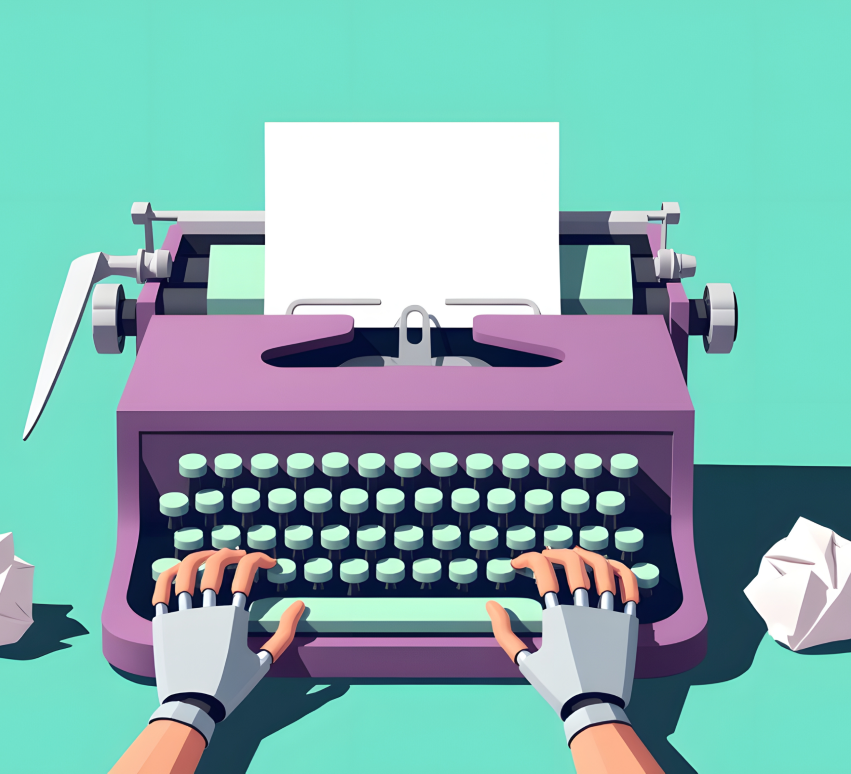

AI-generated content has its own uncanny valley—and it's more dangerous than the original, because it doesn't make you feel anything at all.
There's a term in robotics and animation called the "uncanny valley"—that eerie zone where something looks almost human but not quite, and the not-quite is what makes your skin crawl. A wax figure with dead eyes. A CGI character whose smile doesn't reach the right muscles. The closer it gets to real without actually being real, the worse it feels.
AI-generated content has its own version of this problem, and I think it's more dangerous than the original—because it doesn't make your skin crawl. It doesn't make you feel anything at all.
I've been writing professionally for the better part of 30 years—first in journalism and then in marketing communications. In that time, I've developed a pretty reliable instinct for when a piece of writing is working and when it isn't. And the hardest thing to explain to someone who doesn't write for a living is that the worst kind of bad writing isn't the stuff that's obviously broken. Typos, grammatical disasters, incoherent structure—that stuff is easy to spot and easy to fix. The worst kind of bad writing is the kind that looks, well, fine.
All too often, that's what AI produces. Writing that looks fine.
It hits the brief. It covers the topic. The sentences are grammatically correct and logically ordered. The vocabulary is appropriate. The tone is professional. And if you read it out loud, you will hear absolutely nothing—no rhythm, no surprise, no point of view, no moment where the reader thinks "huh, I never thought of it that way." It's writing that performs competence without possessing a voice.
This misfire is a lot more subtle than the errors we've seen in graphic design. (Remember those early versions of image generation where the agent couldn't get hands to have any semblance of the right number of fingers, or had bizarro-creepy eye placement/size/count?) But it's no less important.
There's a difference between writing that covers a topic and writing that makes an argument about a topic. At the moment, AI is pretty darn good at the first and close to incapable of the second.
We worked on a website for a financial services client not long ago. The AI-generated draft of their "About" page was, by every measurable standard, fine. It mentioned their history, their values, their commitment to clients, their community involvement. It used all the right words. And it read exactly like the "About" page of every other financial services company in the country. You could have swapped the name at the top and it would have worked for any of them!
The version we wrote took a different approach. Instead of trying to say everything, it said one thing clearly: this is a bank that has been in the same community for over a century, and that longevity isn't an accident—it's a choice they make every year to stay local when they could have scaled up and moved on. Same facts, same company, completely different piece of writing. One was a summary. The other was a stance.
AI doesn't take stances. It doesn't have stakes in the outcome. It doesn't know that the CEO of the bank takes enormous personal pride in the fact that they've never been acquired, and that this pride should be the emotional engine of everything on the site. That's not information you find in a prompt. That's information you get from sitting in a room with someone and listening.
In my experience, AI seems to get you about 80% of the way to a finished piece. And for someone without a trained ear, that 80% feels done. The sentences are clean. The structure makes sense. Nothing is misspelled. So they publish it, or they send it, or they post it on their website, and they move on. And the 20% that's missing—the voice, the specificity, the thing that would have made someone actually remember what they read—never sees the light of day. Basically, the special sauce gets left off the burger.
This is the real threat that AI poses to content quality. It's not that it produces garbage. It's that it produces something just good enough to lower the bar without anyone noticing the bar has moved. Over time, everything starts to sound the same. Every company's website reads like every other company's website. Every LinkedIn post has the same cadence, the same structure, the same vocabulary. The differentiation disappears, and nobody can figure out why their content "isn't performing" —especially when it all looks perfectly fine on the screen.
When a client hires us, they're not paying for words on a page. A machine can produce words on a page basically for free. They're paying for judgment—the ability to look at a blank screen and decide not just what to say, but what not to say. What to emphasize. What to bury. What tone to strike for this particular audience at this particular moment. They're paying for someone who knows their business well enough to write something that could only be about them and not about their competitor down the street. (By the way, easily my favorite part of the job is chatting with other business owners, getting to know their business, their challenges, their goals, etc.—and that's a big part of why we often nail it.)
Honestly, I'm not so sure that's a skill that AI threatens. If anything, AI has probably made us more valuable to our clients, because the ocean of competent-but-forgettable content keeps rising, and the writing that actually has a pulse stands out more than ever.
We're not strictly anti-AI. Our team spans a pretty broad spectrum of opinion on the subject. We use AI tools in some departments at Propagate, and I'll write honestly about that in an upcoming post. But I am against settling—for content that checks the boxes without moving the needle, for writing that looks right but sounds like nothing, for the slow erosion of standards that happens when "good enough" becomes the goal.
The gap between competent and compelling has never been wider. And that gap is exactly where we work.

Mike McKenna is the founder and president of Propagate, leading a dynamic team that guides client ideas from concept through execution and beyond. Mike has been planning, writing, designing, and coding for the web since 1995. His background in web development and journalism—he holds a bachelor's degree from Boston University—makes him both technically savvy and an exceptional writer and storyteller. Combined with his extensive experience in business strategy, he leads with creative vision and practical execution.

Learning about your organization, goals, and challenges is the first step to us helping you propagate your ideas. Let's get on a call for 30 minutes to chat. We want to know all about you and what fuels you.
Schedule 30 Minutes with Us.
We'd love to hear about your ideas, challenges, and thoughts.