
The introduction of truly useful AI tools into the workplace is creating some critical to-dos—first among them: learning from the past.
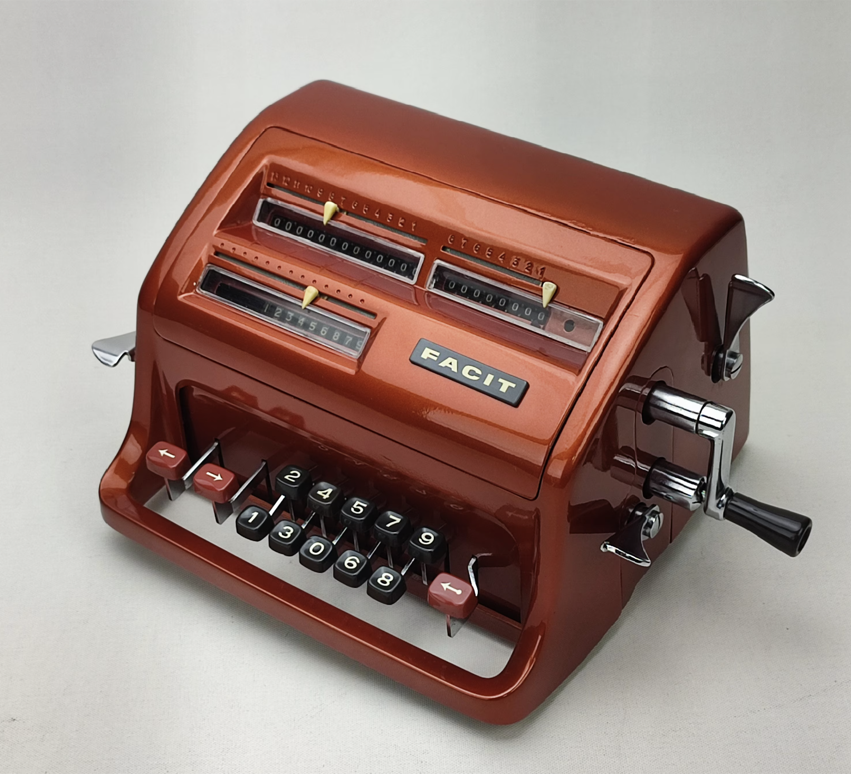
Facit was a highly-profitable, international office equipment manufacturer based in Sweden. They went from total market dominance to completely screwed in just 24 months—and they really should have seen it coming.
Facit AB was a manufacturer of mechanical calculators, based in the small town of Åtvidaberg, which is about 2.5 hours southwest of Stockholm. From the 1930s through the early 1970s, they were the best in the world at what they did—building excellent mechanical calculators. At the company’s peak in 1970, they employed over 14,000 people, sold machines in more than 100 countries, and brought in over a billion Krona annually. A single Facit calculator contained roughly 2,300 precision parts and sold at a premium—about $6,000.00 in today’s money. They had 90 sales offices and 120 service workshops in Sweden alone.
Contrary to popular belief, Facit was not completely oblivious to changes in technology and thus blindsided en route to its grave. Rather, they were quite aware of the electronic calculator’s advent, and simply way too slow to react. As early as 1965, they partnered with Sharp to sell rebranded electronic calculators, moving 4,000 units the first year and 25,000 the next. In 1968, they opened a dedicated electronics factory and hired dozens of electronics engineers. They explored deals with Philips and HP. But electronics never accounted for more than 10% of their revenue. Mechanical R&D still dominated the budget, and the 40-year-old mechanical technology remained the core of the business.
In other words, they were aware of the new technology, treated it a bit like a novelty, and completely failed to recognize its real potential.
The consequences of that mistake came swiftly and thoroughly. In 1970, Facit posted close to $3 million in profit (about $25 million today). By the end of the following year, they’d posted a staggering $54.4 million loss (in modern equivalence)—mechanical orders had been cut in half, and unsold inventory was up 30%. Japanese firms like Sharp, Canon, and Casio had introduced LSI-chip calculators that dropped below mechanical price parity around 1972. By the end of 1972, Facit had laid off nearly 4,000 people and was sold to Electrolux for 64 million SEK. All calculator production ended by 1977.
From the beginning of 1970 to the end of 1971, (roughly 24 months) the company suffered a death cycle that ended the business before there was time to course correct.
The frontier we’re standing on right now is simply wild. There’s no other way to put it.
In 1997, I was a student at Boston University’s College of Communication. The advent of the graphical web had just come about, and as a result, I suffered through many sleepless nights (yes, as a 20 year-old kid), laying awake, overcome by feelings of excitement, opportunity, and entrepreneurial passion.
It’s been almost 30 years since I followed my instincts and started down the path of web-based entrepreneurship, which brought me through the lands of freelancing, solopreneurship, and finally to my position as CEO of Propagate.
Of late, I’ve had a tough time not thinking about the parallels between 1997 and 2026. I’ve returned to the pattern of laying awake at night, overcome by those same feelings—but there is a new one that came along for the ride this time: a strong sense of protectionism.
This is the first time in my career I’ve thought, “OK, this moment has the potential to be our ‘Facit Trap’ (Swedish: Facitfällan).” I have no choice but to respond.
There are three paths available to me as the person ultimately responsible for Propagate’s future. Here’s how I think things could play out.
Scenario 1: We decide AI is a fad—or at best, a distraction—and move on.
In this scenario, we stay the course and just keep doing what we’ve always done. We stay focused on the work we know: design, development, content, strategy. We don’t invest time or money into learning AI tools, building AI-related services, or changing how we operate.
If AI turns out to be an overhyped swing-and-miss, this would be a smart move. We will have avoided wasting resources chasing something that fizzled out, and we stayed focused on our craft while competitors got distracted.*
But if AI doesn’t fizzle out—if it continues to get more capable, more useful, and more practical—then we will have a real problem on our hands. We will have put ourselves at a competitive disadvantage. Our clients will ask questions that we won’t be able to answer. We might be starting from zero in a space where everyone else has a head start. We put ourselves at risk of repeating the Facit scenario.
Scenario 2: We go all in. We throw everything we have—time, talent, energy, focus—into AI.
We pivot. We rebuild our workflows around AI. We reposition the agency as an AI-first company. We chase every new tool, every automation, every efficiency gain.
If AI turns out to be as transformative as the biggest advocates claim, we’re ahead of the curve. We’re early. We built the muscle before the market demanded it.
But here’s what we lose in that scenario: that which makes us different and, well, special. Our value has always been about judgement and creativity. We wouldn’t throw that away in the name of speed or efficiency. It’s the ability to sit with a client, understand what they actually need, and build something specific to solve their challenge(s) that sets us apart—that creative work that requires taste, experience, and a point of view. If we over-pivot, so to speak, we will have abandoned that which our clients trust us with. And we will have asked a team of designers, writers, and strategists to become something they didn’t sign up to be.
Scenario 3: We find the balance.
We lean in to what we do best—the creative work, the strategic thinking, the human relationships—and we let that stand on its own merits. At the same time, we make sure we understand AI well enough to use it where it genuinely helps us—and then we transfer that knowledge and bring it to the table for our clients as well.
This may prove to be the hardest of the three options, but it is the right choice. It’s the scenario where we can continue to be the same company—with the same values and the same people—and also be positioned to help our clients succeed, no matter what the market looks like two or three years from now.
*This game theory leaves out the important ethical questions and concerns about AI, which I intend to address soon.

Mike McKenna is the founder and president of Propagate, leading a dynamic team that guides client ideas from concept through execution and beyond. Mike has been planning, writing, designing, and coding for the web since 1995. His background in web development and journalism—he holds a bachelor’s degree from Boston University—makes him both technically savvy and an exceptional writer and storyteller. Combined with his extensive experience in business strategy, he leads with creative vision and practical execution.

Learning about your organization, goals, and challenges is the first step to us helping you propagate your ideas. Let's get on a call for 30 minutes to chat. We want to know all about you and what fuels you.
Schedule 30 Minutes with Us.
We'd love to hear about your ideas, challenges, and thoughts.